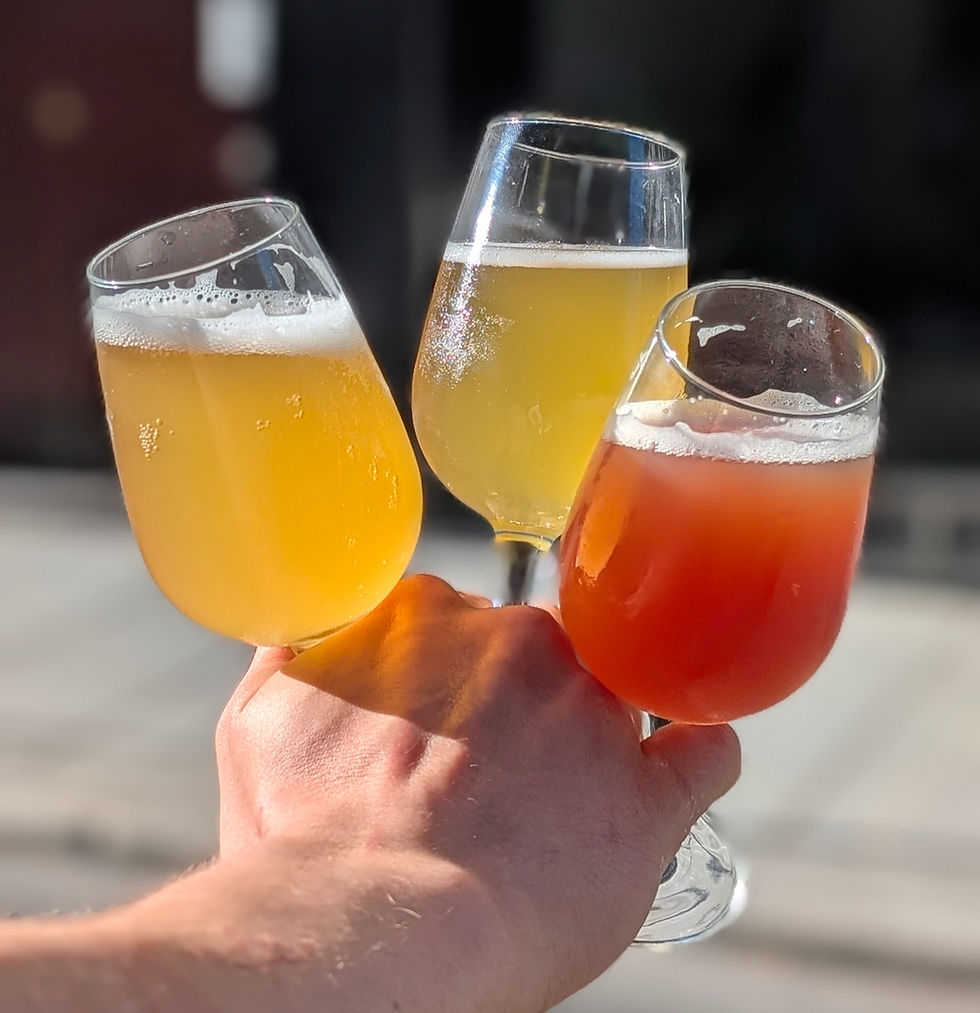
How we treat Paris tap water to brew NEIPAs

Article written by Émile Taverne
Co-founder and brewer at Kilomètre Zéro, homebrewing since 2015
Reviewed by Romain Bretoneiche, brewer and managing director
A NEIPA is hazy, juicy, and you can smell the mango and citrus from three metres away. What people talk about less is that before the hops, before the malt, before the yeast, everything starts with water. And in Paris, the water doesn't do us any favours.
Paris tap water is hard and full of limescale. Perfect for brewing a stout or a porter, much less so for a hoppy beer. The thing is, our customers love IPAs and NEIPAs, and so do we. So we learned to rework it, brew after brew. Today, our NEIPAs sit around 4/5 on Untappd, which is a very good score on the beer geeks' favourite app.
Let me show you how we do it, with a real example: Deux Rivières, the NEIPA we brewed with our friends at Soquee Brewing.

Why water matters so much in beer
Beer is more than 90% water. The minerals it carries affect three things:
Mash pH, meaning the acidity of the water and malt mixture. It drives the enzymes that turn starch into sugar, tannin extraction and how well the aromas hold up.
Mouthfeel. Chlorides bring roundness and a silky texture. Sulphates dry the beer out and push the bitterness forward.
Yeast health, since yeast needs calcium and magnesium to ferment properly.
For a NEIPA, we aim for a mash pH in the ideal 5.2 to 5.4 range, and water that leans clearly towards chlorides: that's what gives the round, juicy texture without any harsh bitterness.
Paris water: perfect for a stout, not for a NEIPA
According to the analyses published by the City of Paris, the city's water has a hardness of 20 to 30 °f depending on the neighbourhood. Above all, it is rich in bicarbonates, often more than 250 mg per litre, with fairly low chlorides and sulphates (around 20 to 30 mg per litre each).
Bicarbonates are the real problem. They push the mash pH up. Brew a pale beer with untreated tap water and you get harsher bitterness, hop aromas that fade fast and a beer that lacks freshness.
With roasted malts, it's the opposite. Those malts are naturally acidic and offset the water's alkalinity. That's why stouts and porters were born in hard-water cities like Dublin and London. Our Nuit Boréale and Varappe do just fine with Paris water. Our NEIPAs, not so much.
Our method, step by step
We're not trying to make perfect water in the abstract. We build tailor-made water for each recipe.
1. Know your water
It all starts with the analysis of the mains water. It gives us hardness, alkalinity and the main minerals. We enter it into our recipe software, which calculates the corrections needed for each style.
2. Knock down alkalinity with acids
To neutralise the bicarbonates, we use three acids depending on the recipe:
AMS, a blend of hydrochloric and sulphuric acid. It lowers alkalinity while adding a little chloride and sulphate.
Phosphoric acid, very neutral in taste, our go-to for beers where we don't want to add anything else.
Lactic acid, which we keep for recipes where a very slight tang is welcome.
We treat the mash water, but also the sparge water. Sparge water that is too alkaline would pull tannins out at the end of lautering, and we'd lose all the benefit of the earlier work.

3. Rebuild the mineral profile
Once alkalinity is under control, we add what's missing:
Calcium chloride, for roundness and the calcium the yeast needs.
Magnesium sulphate (Epsom salt), for magnesium and a touch of sulphate, just enough to keep the beer from feeling heavy.
A pinch of salt, which rounds out the flavours.
4. Measure, every single brew
The calculation is the theory. The pH meter is the reality. We check the mash pH on every brew and adjust if needed. It's a habit we kept from our homebrewing years, and it makes all the difference when you brew several hundred litres at a time.
A real example: Deux Rivières, our NEIPA with Soquee Brewing
Soquee Brewing is a microbrewery in Paris's 20th arrondissement, and a reference in the city when it comes to NEIPAs. Its head brewer, Andrew, is from Georgia, in the United States. We brewed together at our place in République in October 2026.
The name tells our shared story: one river in Picardy, the Brêche, which gave its name to our pale ale, and another in Georgia, the Soquee. A Franco-American NEIPA, with hops from both sides of the Atlantic.
The malts
French Pilsner malt (Soufflet): about 54%, for a clean, bright base.
Wheat malt (Malteurop): about 27%, for body and head retention.
Carapils and flaked oats: about 8% each. Oats bring the silky texture and the classic NEIPA haze.
A touch of maltodextrin, which doesn't ferment and adds even more roundness.
The water
For every hectolitre of mash water, we added about 19 g of calcium chloride, 15 g of magnesium sulphate and 2 g of salt. Alkalinity was knocked down with a blend of AMS and phosphoric acid, dosed to land in the right pH range. The sparge water got the same treatment, only lighter.
The result: water where chlorides clearly outweigh sulphates. Exactly what we want for a round, juicy NEIPA.
The brew
Step mash: 15 minutes at 52 °C to work on proteins (for foam and stable haze), 60 minutes at 69 °C to keep body, then 5 minutes at 78 °C.
Gentle bittering: a little Nugget at the start of the boil, for just 16 IBU.
Hopstand: 15 minutes at 80 °C with Citra (American) and Barbe Rouge (French, with red fruit notes). At that temperature, we extract aroma without adding bitterness.
Dry hop on day 3 of fermentation, Citra and Barbe Rouge again, at about 8 g per litre. That's where the explosive nose comes from.
Fermoale New-E yeast, a strain made for NEIPAs, and 14 days of fermentation at 20 °C.
In the glass: 6.5%, hazy and golden, with peach, citrus, a hint of red fruit and a round mouthfeel. Untappd drinkers give it 4.07/5.

Nothing else is left to chance
Good water is the foundation. But a NEIPA is a fragile beer, and every step counts:
Quality hops, fresh and well stored, because tired hops won't save any recipe.
Isobaric tanks: we transfer and package the beer under pressure, with no contact with air. Oxygen is a NEIPA's worst enemy: it kills the aromas and turns the beer brown within days.
A cold crash at the end of fermentation: we chill the tank to drop out yeast and hop particles and stabilise the beer.
pH and water quality checks on every recipe, as you've seen.
What drinkers say
On Untappd, the go-to app for beer lovers, anything above 4/5 is a very good score. Here's where our latest hoppy beers stand, as of mid-November 2026:
Oasis, 6% NEIPA (Amarillo, Cascade, Sabro): 4.08/5
Deux Rivières, 6.5% NEIPA with Soquee Brewing (Citra, Barbe Rouge): 4.07/5
Canopée, 6.3% NEIPA (Mosaic, Chinook): 4.06/5
Face Nord, 6.3% IPA brewed with Croix de Chavaux brewery in Montreuil: 3.99/5
Nectar and Escale, two NEIPAs: 3.96/5 each


All our beers and their ratings are on our Untappd page.
Homebrewing? Our tips
Get your water report. In Paris, Eau de Paris and the City publish it neighbourhood by neighbourhood.
Start with alkalinity. A little lactic or phosphoric acid already makes a huge difference to a pale beer.
Invest in a pH meter and calibrate it before every brew day.
Use a water calculator (Brewfather has a very good one) rather than adding salts at random.
Go easy on the salts. A few grams too many and the beer turns salty or minerally.

Come and taste our NEIPAs in République
The best way is still to taste. We always have a house NEIPA on tap, at 39 rue Notre-Dame de Nazareth, Paris 3rd, two minutes from République metro. A half pint (25 cl) is €3.50, a pint (50 cl) €6.50, and the €10 tasting flight of 4 house beers is perfect for comparing a NEIPA, a pale ale and a stout.
Want to see behind the scenes? Book a tour of our brewery with one of the brewers. And to get to grips with brewing vocabulary, our beer glossary has you covered.
Sources: water quality analyses published by the City of Paris, Brewfather recipe for Deux Rivières, Untappd ratings checked in November 2026.
Frequently asked questions
Why treat water to brew a NEIPA?
Because water makes up more than 90% of beer. Its minerals set the mash pH and the mouthfeel. A NEIPA needs a controlled pH and chloride-rich water to be round and juicy, without harsh bitterness.
Is Paris tap water good for brewing?
Paris water is hard (20 to 30 °f) and rich in bicarbonates. It suits dark beers such as stouts and porters well, but it has to be corrected for pale, hoppy beers. At Kilomètre Zéro, we treat it on every brew.
How does Kilomètre Zéro treat its brewing water?
We knock down alkalinity with AMS, phosphoric acid or lactic acid depending on the recipe, then rebuild the mineral profile with calcium chloride, magnesium sulphate and a little salt. Mash pH is checked on every brew, and the sparge water is treated too.
What mash pH should you aim for in a NEIPA?
The ideal range is 5.2 to 5.4. It helps the enzymes work, limits tannin extraction and preserves hop aroma.
Where can I drink a NEIPA brewed in Paris?
At Kilomètre Zéro, 39 rue Notre-Dame de Nazareth (Paris 3rd), near République. There is always a house NEIPA on tap: €3.50 for a half pint, €6.50 for a pint. Our latest NEIPAs, Oasis, Deux Rivières and Canopée, are rated above 4/5 on Untappd.
Excessive alcohol consumption is harmful to your health. Please drink responsibly.